


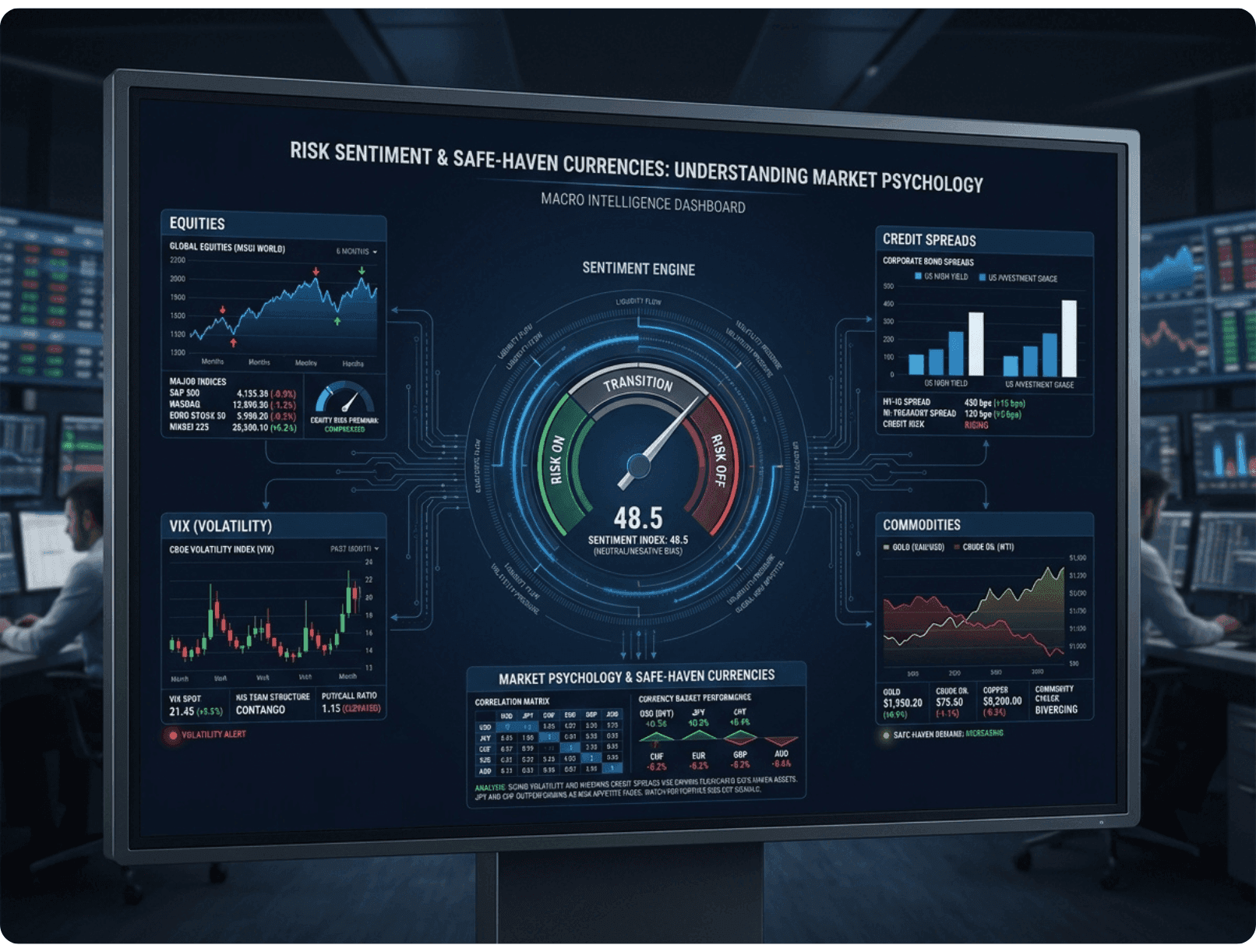
Before a single chart is drawn or a single data point is released, the market has already made a decision about how it feels. That feeling moves currencies. Learning to read it is a different skill from reading price action, and a more durable one.
In March 2020, a thirty four year old primary school teacher in Manchester made one of the most prescient financial decisions of the year. Not because she understood monetary policy, not because she tracked yield spreads, but because she looked at the news and moved her modest savings into cash. She did not know the term risk off. She just knew the world felt dangerous. Somewhere across the city, an algorithm at a hedge fund was doing the same thing, for the same reason, expressed in exactly the same direction, except it was moving two hundred million pounds. The teacher and the algorithm shared a psychology. The currency market recorded them both in the same candle.
Risk sentiment is not a technical indicator. It is not a number released on a schedule. It is the collective emotional and rational state of global market participants at a given moment. Their shared answer to one question: do I want to take risk right now, or protect what I have. That question, asked simultaneously by millions managing trillions, moves currencies more reliably than almost any indicator.
Risk on Appetite for return Capital flows into higher yielding, higher risk currencies. AUD, NZD, CAD and emerging market currencies strengthen. Equities rise. Volatility falls. The world feels manageable.
Transitioning Uncertainty dominates Mixed signals. Positioning is cautious. Participants wait for confirmation. Markets range. Volatility builds quietly.
Risk off Appetite for safety Capital leaves risk assets and moves into preservation. USD, JPY and CHF strengthen. Equities fall. Volatility rises sharply. The world feels unstable.
The currencies that benefit in risk off conditions are not random. They share structural characteristics that make them reliable destinations for capital under stress.
JPY (Japanese yen) The repatriation haven Japan is the largest creditor nation globally. In times of stress, Japanese investors bring money back home. That creates automatic demand for yen, regardless of domestic conditions.
CHF (Swiss franc) The stability haven Switzerland's neutrality, strong financial system, and long history of stability make it a psychological safe zone. Capital flows there because it is trusted to remain steady when other systems are under pressure.
USD (US dollar) The liquidity haven Global trade, debt, and financing run on dollars. In a crisis, the world needs dollars. That demand exists whether or not the US economy looks strong in that moment.
September 2008. Lehman Brothers collapses. The dollar rises against almost every currency globally. Emerging markets fall. The Australian dollar drops sharply. Oil collapses. Equities fall across the board. The yen strengthens as capital returns to Japan. The Swiss franc holds firm as European money flows in. These moves were not driven by domestic economic changes. They were driven by a single shift in psychology. The world decided it wanted safety more than return.
"Risk sentiment is the market's mood, and moods move faster than fundamentals. A central bank takes months to act. The market can shift in a single afternoon."
How to read risk sentiment without institutional tools
Equity markets Indices like the S&P 500 act as a real time proxy for risk appetite. Falling equities signal risk off. Rising equities signal risk on.
Volatility index (VIX) Rising volatility reflects fear. A high VIX aligns with demand for safe haven currencies. A falling VIX reflects stability and risk appetite.
Credit spreads The difference between corporate and government bond yields widens when risk increases. It shows institutions demanding more compensation for risk.
Commodities Oil and copper reflect global growth expectations. Falling prices often signal declining confidence and risk off conditions.
The complication is that sentiment operates across multiple timeframes at once. A short term geopolitical shock can create temporary risk off conditions inside a longer term risk on trend. The trader who reacts to a short spike without understanding the broader context ends up trading noise against structure.
Signal When equities fall, VIX rises, credit spreads widen, and commodities drop together, sentiment is aligned. That is real risk off. Moves that follow tend to sustain.
Trap Chasing the first safe haven spike is often entering at the worst price. Institutions are frequently exiting positions into that spike, not initiating them.
Edge Watch for divergences. If AUD/JPY rises while equities fall, the disagreement matters. Historically, currencies tend to align with equities once the divergence resolves.
The teacher in Manchester and the hedge fund algorithm operated at completely different scales. What they shared was a correct reading of the moment. That reading moved price.
Market psychology is not a soft overlay on hard data. It is a core driver. The feeling that something is wrong often appears in price before it appears in data. Traders who learn to read that shift are not predicting the market. They are listening to it.