


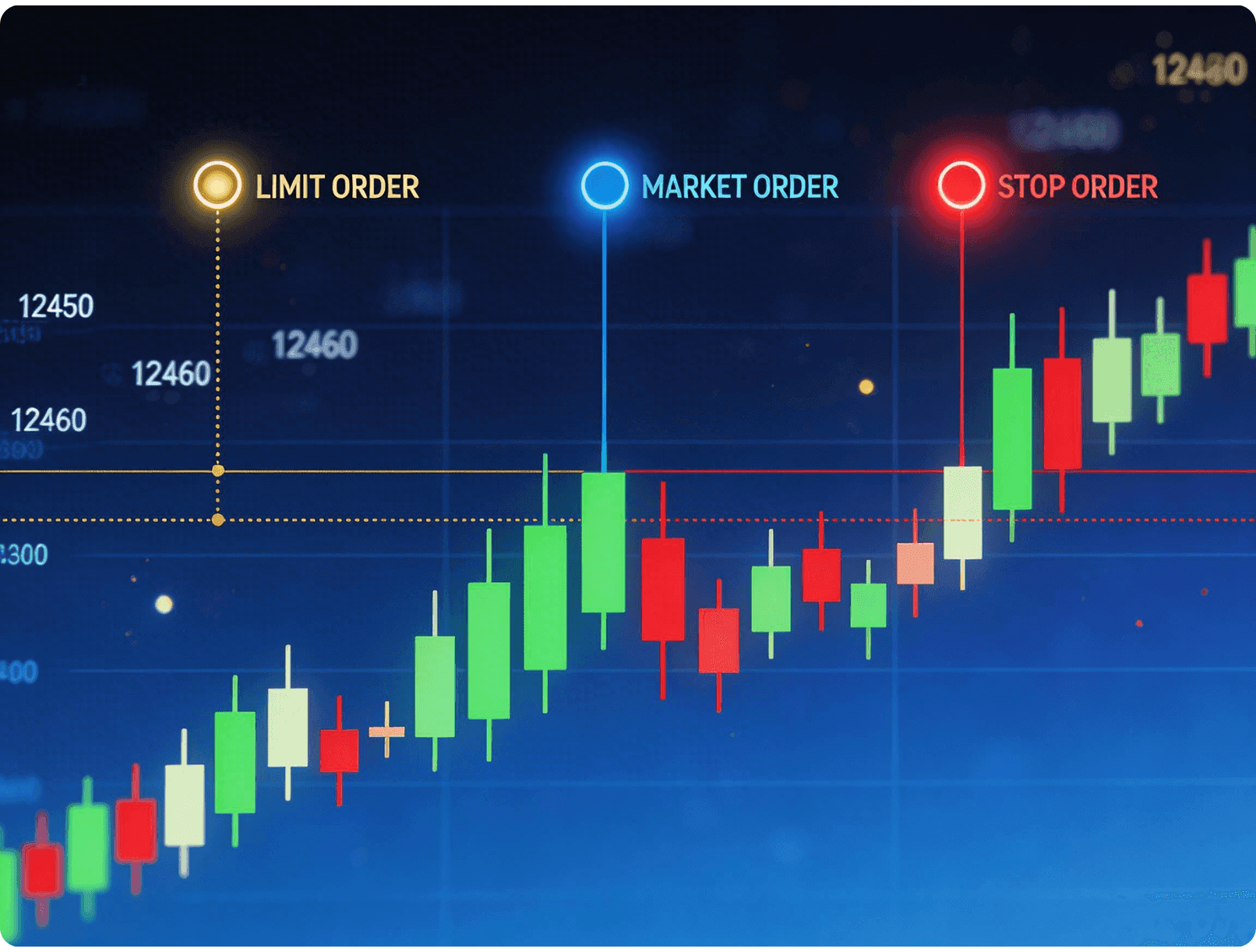
In the fast-paced world of global trading, your success often hinges not just on what you trade, but how you execute that trade. Whether you are looking to capitalise on a sudden spike in Gold volatility or carefully planning an entry into the EURUSD market, the type of order you use can significantly impact your profitability and risk management.
For traders in the UAE, India, and emerging markets, mastering these mechanisms is the first step towards professional consistency. This guide explores the three fundamental order types—Market, Limit, and Stop orders—and provides actionable strategies to help you navigate our robust MT5 platform with confidence and precision.
1. Introduction to Order Types in Trading
An 'order' is simply an instruction you send to your broker to buy or sell an asset. While it sounds simple, the nuance lies in the conditions you attach to that instruction. Do you want the trade executed immediately at any price? Or are you willing to wait for a specific price point?
Understanding these distinctions is vital. Incorrect order usage can lead to 'slippage' (entering a trade at a worse price than expected) or missed opportunities entirely. By leveraging the right order type, you gain control over your entry and exit points, allowing you to manage risk effectively and optimise your trading strategy on My Maa Markets' comprehensive platforms.
2. Market Orders: Speed Over Price
A Market Order is the most basic and common order type. It instructs the broker to buy or sell an asset immediately at the best available current price. It is the 'buy now' button of trading.
Usage: Traders typically use market orders when execution speed is more important than the specific price. For example, if a major economic report is released and the market is moving rapidly, a market order ensures you get into the trade instantly, rather than missing the move.
Pros and Cons:
-
Pro: Guaranteed execution. Unless trading has been halted, your order will be filled.
-
Pro: Simplicity. It requires no price parameters, making it ideal for beginners.
-
Con: Slippage risk. In highly volatile markets, the price at which your order is filled might be different from the price you saw on the screen when you clicked the button.
-
Con: Lack of control. You cannot dictate the exact entry price.
3. Limit Orders: Price Over Speed
A Limit Order is an instruction to buy or sell an asset at a specific price or better. A 'Buy Limit' order is placed below the current market price, while a 'Sell Limit' order is placed above it.
Usage: Imagine Gold is trading at $2,000, but you believe it is overbought and will pull back to $1,990 before rising again. You would place a Buy Limit order at $1,990. Your trade will only execute if the price drops to that level. This is favored by institutional traders who value precision.
Pros and Cons:
-
Pro: Price control. You know exactly the maximum price you will pay or the minimum you will receive.
-
Pro: No slippage. You will never be filled at a price worse than your limit.
-
Con: Execution risk. If the market never reaches your specified price, your trade will not be executed, and you may miss the opportunity.
4. Stop Orders: The Safety Net
A Stop Order (often called a Stop-Loss) becomes a market order once a specified price level (the 'stop price') is reached. Unlike a limit order, which tries to get you a better price, a stop order is typically used to protect you from a worse price.
Usage: The most common use is risk management. If you bought EURUSD at 1.1000, you might place a Sell Stop order at 1.0950. If the rate falls to 1.0950, your order triggers, selling your position to prevent further losses. Conversely, a 'Buy Stop' can be used to enter a trade if the price breaks above a key resistance level.
Pros and Cons:
-
Pro: Automates risk management. It protects your capital without you needing to watch the screen 24/7.
-
Pro: Discipline. It forces you to stick to your trading plan and exit failing trades.
-
Con: Slippage. Once triggered, it becomes a market order, so in a crashing market, your exit price could be lower than your stop price.
-
Con: False triggers. Normal market volatility might trigger your stop just before the price reverses in your favour.
5. Combining Order Types for Effective Strategies
Professional traders rarely use these orders in isolation. The true power of our MT5 platform lies in combining them to create a cohesive strategy.
For instance, an "OCO" (One Cancels the Other) strategy is highly effective for breakout trading. If an asset is trading in a range between $100 and $110, you might place a Buy Stop at $110.50 (to catch a breakout upwards) and a Sell Stop at $99.50 (to catch a breakdown). Whichever triggers first automatically cancels the other, ensuring you are positioned correctly without double exposure.
Another common combination is entering a trade with a Limit Order (for precision) and immediately attaching a Stop Order (for protection) and a Take Profit (another form of Limit Order) to lock in gains.
6. Tips for Choosing the Right Order Type
Selecting the correct order type depends on your strategy and the current market conditions. Here are three practical tips:
-
Assess Volatility: In highly volatile markets, Limit Orders are safer as they prevent you from paying an unexpectedly high price due to slippage.
-
Define Your Goal: If you are trading a long-term trend, a Market Order helps you secure your position immediately. If you are scalping small profits, the precision of a Limit Order is non-negotiable.
-
Check the Spread: On platforms like My Maa Markets, where spreads start from 0.0 pips, Market Orders are more cost-effective than on platforms with wider spreads. However, always account for the spread when setting your Limit and Stop prices.
7. Conclusion: Mastering Order Types for Trading Success
Whether you are a beginner looking to place your first trade or an experienced investor managing a diverse portfolio, understanding the mechanics of Market, Limit, and Stop orders is essential. These tools allow you to execute your strategy with intent, protecting your capital and maximising your potential returns.
At My Maa Markets, we are committed to providing you with the educational resources and robust technology needed to trade with confidence. Our FSC-regulated environment and 24/7 expert support ensure you have a trusted partner by your side as you navigate the global markets.
Ready to apply this knowledge? Open a live account today and experience seamless execution on over 275 trading instruments.
Disclaimer: Trading involves significant risk and may not be suitable for all investors. You should carefully consider your investment objectives, experience level, and risk appetite. Only invest money you can afford to lose.