


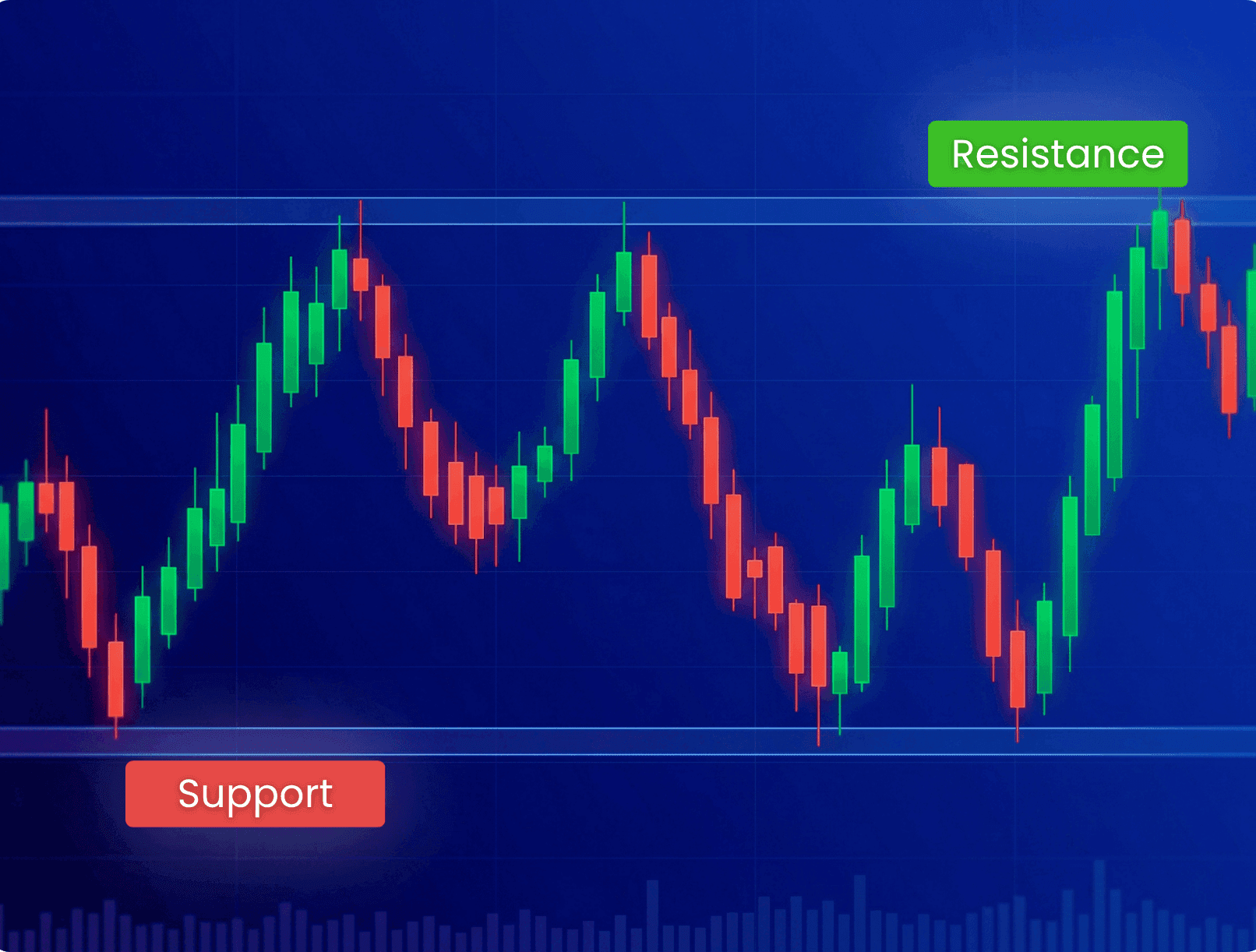
For any trader stepping into the world of financial markets—whether you are looking at the EURUSD pair or tracking Gold Spot prices—understanding price movement is crucial. It is the difference between making an informed decision based on analysis and simply guessing. At the heart of technical analysis lies the concept of support and resistance. These are not just lines on a chart; they are the battlegrounds where supply and demand meet, shaping the future direction of price action.
In this guide, we will break down these essential concepts, helping you identify key price levels to refine your trading strategy. By mastering support and resistance, you gain the ability to interpret market psychology and identify potential entry and exit points with greater precision.
1. Introduction to Support and Resistance in Technical Analysis
Support and resistance are the pillars of technical analysis. They represent specific price points on a chart where the forces of buying and selling intersect. Think of the market as a constant tug-of-war between bulls (buyers) and bears (sellers). Support and resistance levels act as barriers that price action often struggles to cross.
These levels exist because of market memory and psychology. Traders remember past prices where an asset reversed direction, and they often place their orders around these same levels again. For instance, if Gold (XAUUSD) has repeatedly bounced back up from $1,900, traders will view this as a significant psychological level. Recognising these zones allows you to anticipate potential market reversals or breakouts, adding a layer of structure to the often chaotic nature of price movements.
2. Understanding Support Levels: Definition and Identification
A support level is a price point where a downtrend tends to pause due to a concentration of demand (buying interest). As the price drops, it becomes cheaper and more attractive to buyers. Eventually, the buying pressure overcomes the selling pressure, and the price stops falling and bounces back up. It is essentially a "floor" that supports the price. To identify a support level, look for a low point on the chart that price has reached but failed to break through multiple times. If you see the EURUSD pair dropping to 1.0500 and then rallying upwards on three separate occasions, 1.0500 is a verified support level. When price approaches this "floor" again, technical analysts anticipate that buyers will step in once more.
Pro Tip: Don't treat support as a precise number (e.g., 1.17376). Instead, view it as a "zone" or area on the chart. Prices often dip slightly below a support line before reversing, so allowing a margin for error can prevent premature exits.
3. How to Identify Strong Support Levels
Not all support levels are created equal. Some are minor hurdles, while others are concrete walls. A strong support level is one that has been tested multiple times over a longer period without breaking. The more times the price touches a support level and bounces off it, the more significant that level becomes.
Data suggests that support levels identified on higher timeframes (like Daily or Weekly charts) are generally more reliable than those on lower timeframes (like 15-minute charts). For example, a support level on a Weekly chart that has held firm for six months carries far more weight than a level formed over the last two hours. Additionally, round numbers (like 1.2000 or 1.5000) often act as strong psychological support because traders tend to place buy orders at these distinct milestones.
Pro Tip: Look for high volume during the bounce. If the price hits a support level and then rallies on high trading volume, it confirms that institutional buyers are defending that level aggressively.
4. Understanding Resistance Levels: Definition and Identification
Opposite to support, a resistance level is a price point where an uptrend tends to pause due to a concentration of supply (selling interest). As the price rises, it becomes more expensive, and sellers become more inclined to sell while buyers become hesitant. This creates a "ceiling" that resists further upward movement.
To identify resistance, look for high points on the chart where the price has struggled to break through. If a stock climbs to $150 but repeatedly falls back down from that price, $150 is the resistance level. It represents a zone where the market currently believes the asset is overvalued, triggering a sell-off.
Pro Tip: Draw horizontal lines connecting significant price peaks. The more peaks that align near the same price, the clearer the resistance zone becomes.
5. How to Identify Strong Resistance Levels
Similar to support, the strength of a resistance level is determined by its history. A resistance level that has rejected price advancements three or four times is considered a major barrier. Historical data shows that when a major resistance level is finally broken, the breakout can be explosive, as it indicates a significant shift in market sentiment.
Another factor in identifying strength is the recency of the level. A resistance level established in the current market environment is often more relevant than one established five years ago. Furthermore, moving averages can often act as dynamic resistance levels. For instance, in a downtrend, the price will often rise to touch the 50-day moving average before falling again, making that average a strong resistance indicator.
Pro Tip: Watch for "polarity changes." When a strong resistance level is finally broken, it often turns into a support level for future price action. The ceiling becomes the new floor.
6. Using Support and Resistance in Trading Strategies
Integrating these levels into your strategy involves two primary approaches: the "Bounce" and the "Break." In a range-bound market, traders often buy near support (expecting a bounce) and sell near resistance. Conversely, in a trending market, traders look for "breakouts"—buying when price decisively breaks above resistance or selling when it shatters support.
For example, if you identify a strong resistance level at $2,000 for Gold, a breakout strategy would involve placing a buy order slightly above $2,000. If the price surges through this ceiling, it confirms strong bullish momentum. However, prudent risk management is essential. Always place stop-loss orders. If you buy at support, your stop-loss should be just below that support zone to protect your capital if the floor gives way.
Pro Tip: Never trade blindly. Wait for a confirmation candle. If price hits support, wait for a green (bullish) candle to close before entering a buy trade to confirm the bounce is actually happening.
7. Common Mistakes to Avoid When Trading Support and Resistance
One of the most frequent errors beginners make is assuming these levels are impenetrable. Support and resistance levels break all the time; that is how trends change. Relying on them as guarantees rather than probabilities can lead to significant losses.
Another common mistake is "front-running" the trade—placing an order before the price has actually reached the level or confirmed a reversal. This is akin to trying to catch a falling knife. Additionally, ignoring the broader market context can be dangerous. A strong support level might not hold if there is a major economic news release (like a Non-Farm Payroll report) that drastically alters market sentiment.
Pro Tip: Avoid drawing too many lines on your chart. If you mark every minor high and low, your chart will become cluttered and confusing. Focus only on the most obvious, major levels that stand out clearly.
8. The Importance of Combining Support and Resistance with Other Indicators
While support and resistance are powerful, they should rarely be used in isolation. To increase the probability of a successful trade, combine them with other technical indicators. This is known as "confluence."
For instance, if the price hits a support level and, at the same time, the Relative Strength Index (RSI) shows the asset is oversold, the likelihood of a bounce increases significantly. Similarly, candlestick patterns like a "Hammer" or "Engulfing" pattern occurring exactly at a support level provide a much stronger signal than the support level alone. Using tools available on advanced platforms like MetaTrader 5 allows you to layer these indicators effectively.
Pro Tip: Use trendlines in conjunction with horizontal levels. Where a diagonal trendline intersects with a horizontal support/resistance level, it creates a "crosshair" of high probability for a price reaction.
Conclusion: Mastering Support and Resistance for Successful Trading
Support and resistance are the foundational vocabulary of the market's language. By learning to read these levels, you move from gambling to strategic trading, understanding where the market is likely to pause, reverse, or accelerate. However, remember that no single tool guarantees success. Trading involves significant risk, and it is vital to combine technical analysis with robust risk management.
If you are ready to put these concepts into practice, having the right environment is key. Access to real-time data, advanced charting tools, and a secure regulatory environment can make all the difference in your trading journey.