


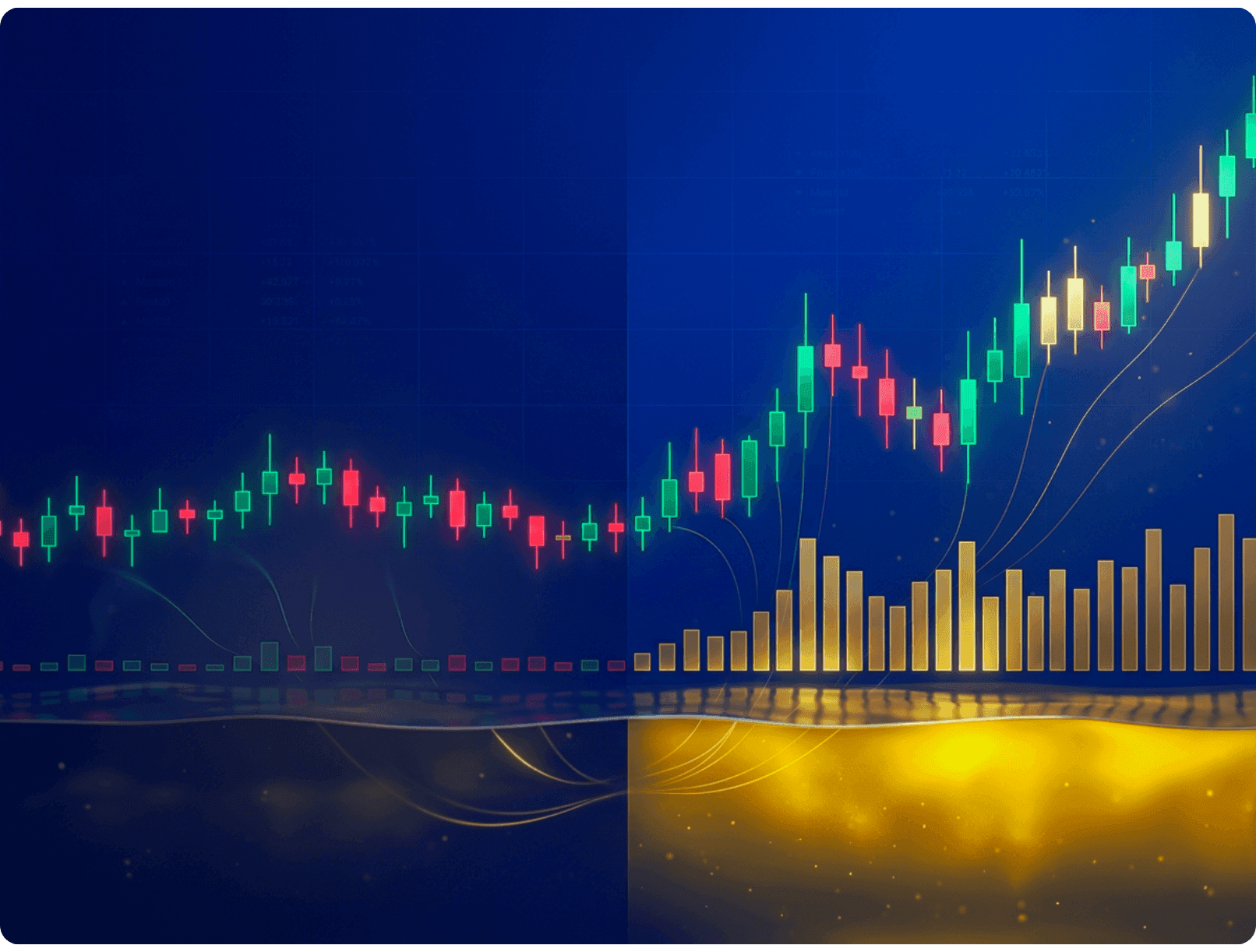
Many new traders make the mistake of focusing solely on price action. While price tells you where the market is, it doesn't tell you the conviction behind the move. To truly understand market dynamics, you need to look at the fuel driving the engine: volume and liquidity.
Mastering these two concepts is crucial for distinguishing between a genuine trend and a false breakout. Whether you are trading forex, metals, or indices, understanding the relationship between volume and liquidity can significantly improve your execution and risk management. In this guide, we break down exactly what these terms mean and how you can use them to make more informed trading decisions.
1. What is Trading Volume?
At its core, trading volume represents the total number of shares, contracts, or lots traded within a specific timeframe. It is a direct measure of market activity and interest. When you see a price chart, volume is typically represented by vertical bars at the bottom, indicating how much buying and selling pressure exists at any given moment.
For example, if the EUR/USD pair moves 50 pips on high volume, it indicates that major institutional players—banks, hedge funds, and large corporations—are participating in the move. Conversely, if the price drifts 50 pips on very low volume, it suggests a lack of conviction, meaning the price could easily reverse. Think of volume as the "vote" of the market; the higher the volume, the more traders are voting in favour of the current price direction.
2. Why Volume Matters
Volume validates price trends. A common axiom among professional traders is that "volume precedes price." This means that significant changes in volume often occur before significant changes in price, offering a potential early warning system for attentive investors.
Key principles of volume analysis include:
-
Trend Confirmation: In a healthy uptrend, volume should increase as price rises and decrease as price retraces (pulls back). This shows that interest is aligned with the trend.
-
Weakness Signalling: If the price hits a new high but volume is lower than the previous high, this is known as "divergence." It suggests the trend is running out of steam and a reversal may be imminent.
💡 Expert Tip: Watch for volume spikes at key support and resistance levels. A breakout accompanied by high volume is far more likely to be genuine than one with low trading activity.
3. Liquidity Explained
While volume measures activity, liquidity measures the ease with which an asset can be bought or sold without causing a drastic change in its price. A highly liquid market, such as major forex pairs like EUR/USD or USD/JPY, has a vast number of buyers and sellers active at all times. This creates a "deep" market.
Why is high liquidity vital for your strategy?
-
Tighter Spreads: In liquid markets, the difference between the buy and sell price (the spread) is usually very small. At My Maa Markets, for instance, high liquidity allows us to offer spreads from 0.0 pips on major pairs.
-
Faster Execution: High liquidity ensures your orders are filled instantly at the price you want, reducing "slippage"—the difference between expected price of a trade and the price at which the trade is executed.
Conversely, illiquid markets (often found in exotic currency pairs or small-cap stocks) can be volatile and expensive to trade, as a single large order can shift the price significantly.
4. The Volume and Liquidity Relationship
Volume and liquidity are deeply interconnected. Generally, high volume leads to high liquidity. When more people are trading, it becomes easier to find someone to take the other side of your trade. However, it is possible to have high volume but low liquidity during times of extreme market panic, where everyone is trying to sell, but no one wants to buy.
Understanding this relationship helps you gauge market health:
-
High Volume + High Liquidity: This is the ideal trading environment. It represents a stable, active market with tight spreads and smooth price action.
-
Low Volume + Low Liquidity: This creates a choppy, unpredictable market. Prices may jump erratically, and spreads often widen, increasing your trading costs.
💡 Expert Tip: Avoid trading during major news releases if you are a beginner. Liquidity often dries up seconds before a major announcement, leading to widened spreads and volatile price swings, even if volume spikes immediately after.
5. How to use Volume in your Trading Strategy
Integrating volume analysis into your routine does not require complex algorithms. It starts with observing how price behaves relative to trading activity.
Here is a practical framework for using volume:
-
Confirm Breakouts: If you see price breaking above a resistance level, check the volume. Is the bar significantly higher than the average of the last 20 bars? If yes, the breakout has institutional backing.
-
Identify Exhaustion: If price falls sharply after a long downtrend and volume spikes to an extreme high (a "climax"), it often marks the bottom. This is known as capitulation, where the last of the sellers have exited, paving the way for a reversal.
-
Analyse Pullbacks: If you are trading a trend, look for low volume during corrections against the trend. This indicates that traders are simply taking profits, not reversing their positions.
By combining these volume insights with a platform that offers deep liquidity, you position yourself to trade with the current of the market rather than against it.