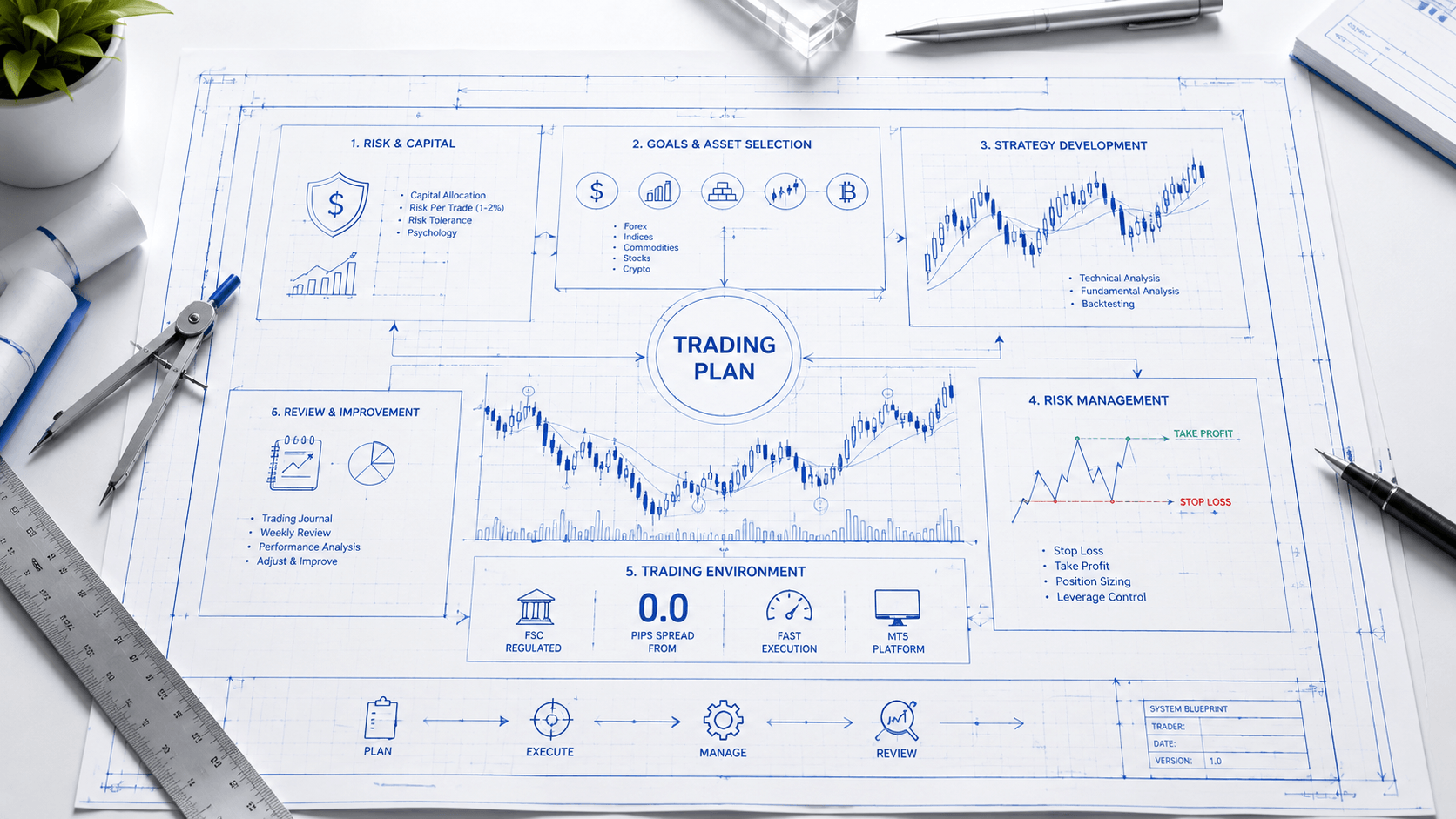



Trading in global markets offers significant opportunities, but it also comes with inherent risks. Whether you are scalping the forex markets or holding long-term stock positions, one metric stands as a cornerstone of sustainable trading: the risk-reward ratio. Understanding this concept is essential for protecting your capital and optimising your potential returns.
This guide will walk you through the mechanics of risk-reward ratios, how to calculate them, and how to implement them effectively into your trading strategy. By mastering this tool, you can make more informed decisions and approach the markets with greater confidence.
1. Introduction to Risk-Reward Ratios: Definition and Importance
The risk-reward ratio represents the relationship between the potential loss (risk) and the potential gain (reward) of a specific trade. It essentially answers the question: "How much am I willing to risk to achieve a certain profit?"
For instance, a ratio of 1:3 means you are risking £1 to potentially gain £3. This metric is crucial because it helps traders quantify the viability of a trade before entering the market. A positive risk-reward ratio ensures that your winning trades can cover the losses from your losing trades, which is vital for long-term profitability in volatile markets like Forex and Commodities.
2. Step-by-Step Guide to Calculating Risk-Reward Ratio
Calculating your risk-reward ratio is a straightforward process that should be performed before every trade execution.
-
Step 1: Determine your entry price. This is the price at which you intend to buy or sell the asset.
-
Step 2: Set your stop-loss. Decide the price level at which you will exit the trade if it goes against you. The difference between your entry and stop-loss is your "risk".
-
Step 3: Set your take-profit. Decide the price level at which you will exit the trade to secure profit. The difference between your entry and take-profit is your "reward".
-
Step 4: Divide the risk by the reward.
○ Example: You buy a stock at £100. You set a stop-loss at £90 (Risk = £10) and a take-profit at £120 (Reward = £20).
○ Calculation: 10 / 20 = 0.5. This translates to a 1:2 risk-reward ratio.
3. Benefits of Using Risk-Reward Ratios in Trading
incorporating a structured risk-reward approach offers several distinct advantages for traders of all levels:
-
Emotional Discipline: By defining your exit points (both loss and profit) beforehand, you remove emotional decision-making from the heat of the moment.
-
Profitability with Lower Win Rates: With a high risk-reward ratio (e.g., 1:3), you can be profitable even if you lose more trades than you win. If you win one trade gaining £300 and lose two trades losing £100 each, you are still net positive £100.
-
Capital Preservation: It forces you to consider the downside of every trade, ensuring you never risk more than your account can handle.
4. Common Mistakes to Avoid When Using Risk-Reward Ratios
While the concept is simple, application can be tricky. Here are common pitfalls to avoid:
-
Setting Unrealistic Targets: Placing a take-profit level too far away just to achieve a "good" ratio, ignoring key resistance levels or market volatility.
-
Moving Stop-Losses: Widening your stop-loss when a trade goes against you destroys the integrity of the ratio and increases risk exposure.
-
Ignoring Win Rate: A 1:5 ratio looks excellent, but if your strategy only wins 5% of the time, the ratio alone will not save your account. The ratio must be balanced with your strategy's probability of success.
5. How to Incorporate Risk-Reward Ratios into Trading Strategies
To effectively use this metric, it must be integrated into your broader trading plan.
-
Scalping: Scalpers often use tighter ratios (e.g., 1:1 or 1:1.5) due to the high frequency of trades and shorter durations.
-
Swing Trading: Swing traders usually aim for higher ratios (1:3 or higher) as they hold positions for days or weeks to capture larger market moves.
-
Trend Following: When following a strong trend, traders might use a trailing stop. This dynamic approach allows the "reward" side of the ratio to grow indefinitely while the risk remains capped.
6. The Role of Leverage in Risk-Reward
Leverage allows traders to control larger positions with a smaller amount of capital. At MY MAA MARKETS, clients have access to extensive leverage up to 1:500.
While leverage can amplify returns, it significantly impacts the "risk" side of your ratio. A highly leveraged position means that a small price movement can result in a quick hit to your stop-loss. When using high leverage, position sizing becomes critical to maintain a healthy risk-reward ratio. You must ensure that the monetary value of your risk does not exceed a small percentage (e.g., 1-2%) of your total account balance.
7. Risk Disclosure: Understanding the Risks of CFDs and Margin FX
It is vital to approach trading with transparency regarding the risks involved. CFDs and Margin FX are leveraged products that carry a high level of risk to your capital. Trading is not suitable for everyone and may result in you losing substantially more than your initial investment.
You do not own, or have any right to the underlying assets. You should only trade with money you can afford to lose. Before deciding to trade, you should carefully consider your investment objectives, level of experience, and risk appetite.
8. Real-Life Examples of Successful Risk-Reward Strategies
Consider a trader focusing on the EUR/USD pair. They identify a support level at 1.1750 and decide to enter a long position at 1.1760.
-
Scenario A (Poor Ratio): Stop-loss at 1.1730 (30 pips risk) and Take-profit at 1.1780 (20 pips reward). Ratio: 1.5:1. This requires a very high win rate to be profitable.
-
Scenario B (Strong Ratio): Stop-loss at 1.1730 (30 pips risk) and Take-profit at 1.1850 (90 pips reward). Ratio: 1:3. Here, the trader targets a major resistance level, offering a substantial reward for the risk taken.
9. Tools and Platforms for Effective Risk-Reward Analysis
Modern trading platforms provide tools to automate these calculations. On the MY MAA MARKETS platform, you can utilise advanced charting tools to visualise your risk and reward levels directly on the chart.
-
MetaTrader 5 (MT5): Use the 'Fibonacci Expansion' or custom drawing tools to map out potential profit targets relative to your stop-loss.
-
Position Size Calculators: Input your account balance, risk percentage, and stop-loss size to determine the exact lot size needed to maintain your desired risk profile.
10. Conclusion: Maximizing Profits While Minimizing Losses
Mastering the risk-reward ratio is a journey of discipline and strategic planning. It is not about avoiding losses entirely—losses are a natural part of trading—but about ensuring that your winning trades significantly outperform your losing ones. By combining this disciplined approach with a regulated broker and robust trading infrastructure, you place yourself in a strong position to navigate the financial markets.
Ready to apply these strategies in the live markets? Open an account with MY MAA MARKETS today to access 275+ trading instruments, competitive spreads from 0.0 pips, and professional support to guide your trading journey.