


In the fast-paced world of trading, understanding market momentum is crucial for making informed decisions. The Relative Strength Index (RSI) stands out as one of the most reliable and widely used technical indicators for gauging this momentum. Whether you are a beginner looking to understand market trends or an experienced trader refining your strategy, mastering RSI can provide significant insights into potential price reversals and trend strengths.
This guide explores the essentials of the RSI, breaking down its calculation, interpretation, and practical application. By the end, you will have a clearer understanding of how to integrate this powerful tool into your trading toolkit to identify opportunities with greater confidence.
1. What is the Relative Strength Index (RSI)?
The Relative Strength Index (RSI) is a momentum oscillator that measures the speed and change of price movements. Developed by J. Welles Wilder Jr. in 1978, it is displayed as a line graph that moves between two extremes, specifically reading from 0 to 100.
Unlike trending indicators that smooth out price data, the RSI is designed to identify overbought or oversold conditions in a traded asset. When the RSI rises, it indicates strong upward momentum; conversely, a falling RSI suggests that the bears are taking control. It is a staple on trading platforms like MetaTrader 5 (MT5), allowing traders to visualize the strength of a specific currency pair, stock, or commodity instantly.
2. How is RSI Calculated?
While most modern trading platforms automatically calculate RSI for you, understanding the math behind it helps in interpreting its signals correctly. The formula relies on average gains and average losses over a specific period—typically 14 periods.
The formula is:
RSI = 100 – [100 / (1 + Relative Strength)] Where Relative Strength (RS) = Average Gain / Average Loss.
To calculate this, you first determine the average percentage gain and average percentage loss over the chosen period (e.g., 14 days).
-
Average Gain: The sum of all gains during the period divided by the number of periods.
-
Average Loss: The sum of all losses during the period divided by the number of periods.
As price moves up, the 'Average Gain' increases, pushing the RSI closer to 100. If prices fall, the 'Average Loss' increases, pushing the RSI closer to 0.
3. Interpreting Overbought and Oversold Levels
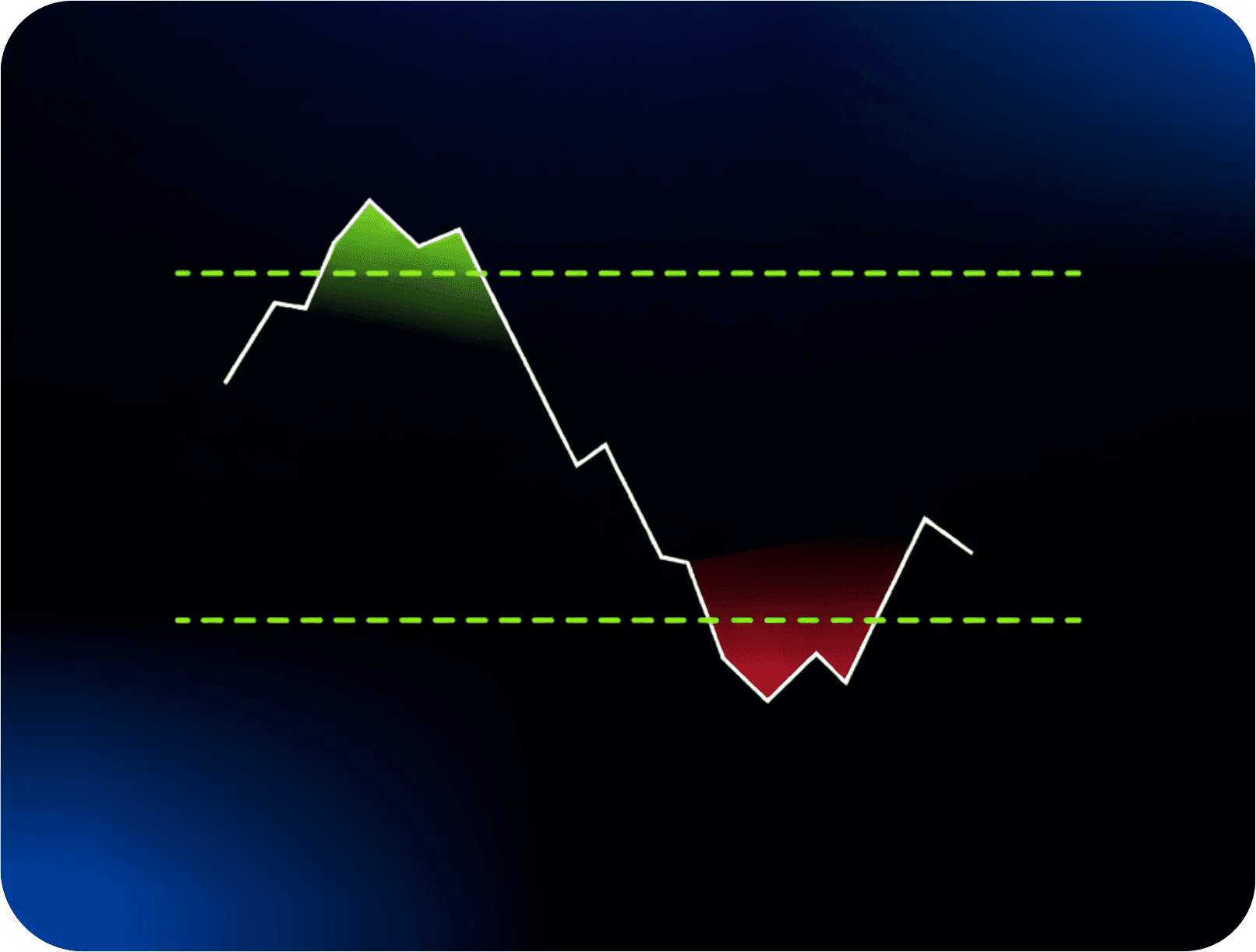
The primary use of RSI is to identify potential reversal points through overbought and oversold levels.
-
Overbought (Above 70): When the RSI crosses above the 70 mark, the asset is considered "overbought." This suggests that the price has risen significantly and might be due for a correction or a pullback. Traders often view this as a potential signal to sell or exit long positions.
-
Oversold (Below 30): Conversely, an RSI reading below 30 indicates that the asset is "oversold." This implies that the selling pressure has been intense and might be nearing exhaustion, potentially leading to a price bounce. Traders often look for buying opportunities in this zone.
Pro Tip: In strong trends, assets can remain overbought or oversold for extended periods. Do not rely solely on these levels; wait for the RSI to cross back below 70 or above 30 for a confirmation signal.
4. Identifying RSI Divergence
Divergence occurs when the price of an asset moves in the opposite direction of the RSI indicator. This is often a powerful signal that the current trend is weakening and a reversal may be imminent.
There are two main types of divergence:
-
Bullish Divergence: This happens when the price makes a lower low, but the RSI makes a higher low. It suggests that while the price is falling, the selling momentum is slowing down, indicating a potential upward reversal.
-
Bearish Divergence: This occurs when the price makes a higher high, but the RSI makes a lower high. This indicates that buying momentum is fading despite the rising price, often signaling a potential downward correction.
Recognising divergence requires practice, but it is a favourite strategy among professional traders for anticipating market turns before they happen.
5. Using RSI with Other Indicators
While RSI is powerful on its own, it is most effective when combined with other technical tools. Relying on a single indicator can sometimes lead to false signals, known as "whipsaws."
To increase the reliability of your trade setups:
-
Combine with Trend Lines: Use RSI to confirm support and resistance levels. If an asset hits a major resistance level and the RSI is overbought, the sell signal is stronger.
-
Pair with MACD: The Moving Average Convergence Divergence (MACD) helps confirm trend direction. If MACD signals a crossover and RSI is moving out of an oversold zone, it provides a double confirmation for entry.
-
Check Volume: High trading volume during an RSI reversal adds validity to the move, suggesting real market participation behind the price change.
- The Limitations of RSI
Like all technical indicators, the RSI is not infallible. It acts as a lagging indicator, meaning it reacts to past price data rather than predicting the future with certainty.
-
False Signals: In volatile markets, the RSI may frequently cross the 70 or 30 levels without a significant price reversal, leading to false buy or sell signals.
-
Strong Trends: During a strong bull or bear market, the RSI can stay in overbought or oversold territory for days or weeks. Selling simply because RSI is >70 in a strong bull market can result in missed profits.
It is vital to use RSI as part of a comprehensive trading strategy that includes risk management and fundamental analysis.
Risk Disclosure
CFDs and Margin FX are leveraged products that carry a high level of risk to your capital. Trading is not suitable for everyone and may result in you losing substantially more than your initial investment. You do not own, or have any right to the underlying assets. You should only trade with money you can afford to lose.
Conclusion
The Relative Strength Index is a versatile tool that can enhance your ability to read market momentum and identify potential entry and exit points. By understanding its calculations, recognizing key levels, and spotting divergences, you can make more calculated trading decisions. However, always remember that no indicator guarantees success.
Ready to apply this knowledge to the live markets? Open a live account with My Maa Markets today to access advanced charting tools on MT5 and trade with competitive spreads starting from 0.0 pips.