


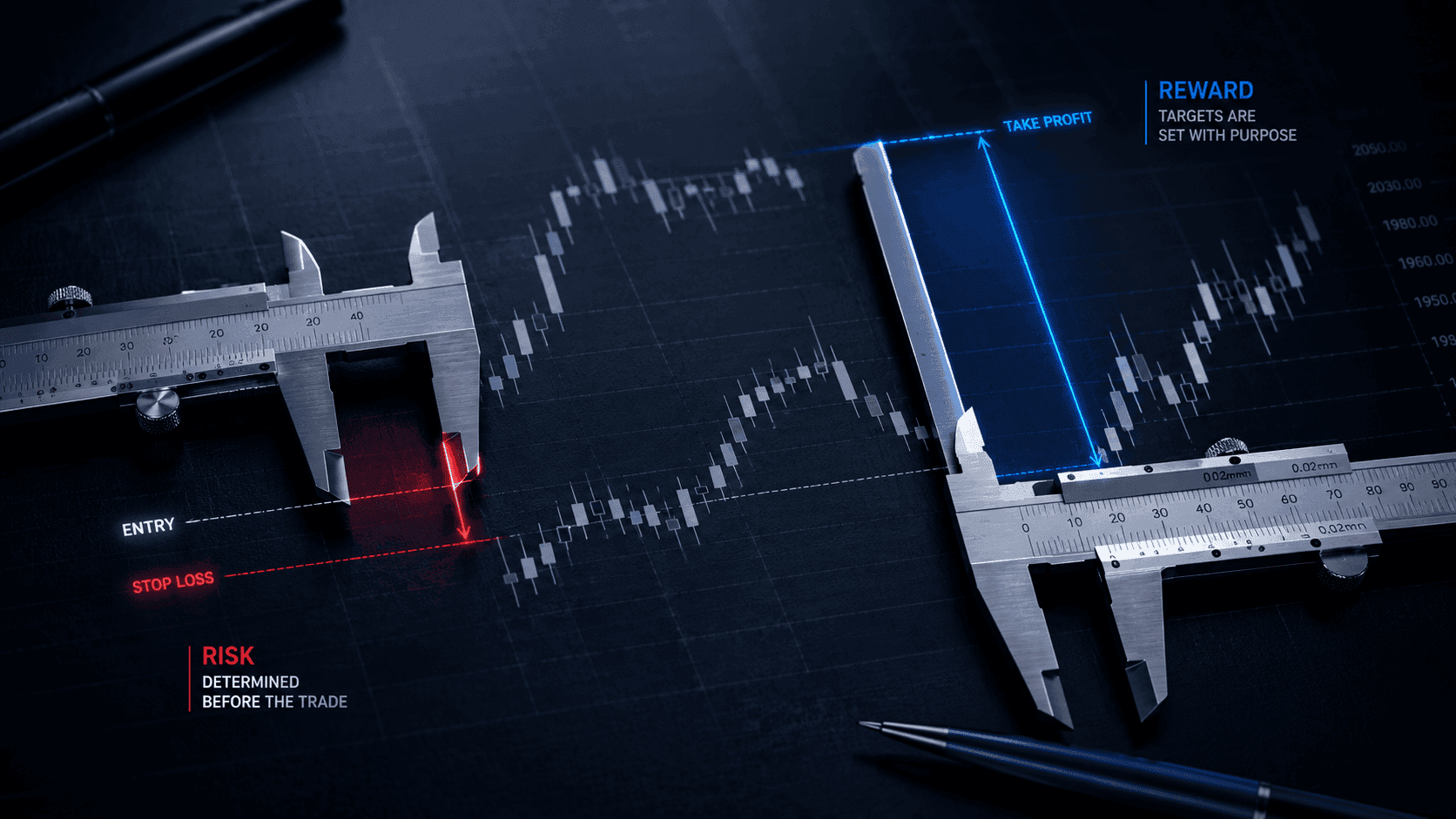
In the fast-paced world of trading, enthusiasm often overshadows strategy. The allure of potential profit can cloud judgment, leading many traders to enter positions without a clear exit plan. However, the difference between a gambler and a professional trader lies in one fundamental concept: Risk Management.
At MY MAA MARKETS, we believe that protecting your capital is just as important as growing it. Understanding the Risk-Reward Ratio (RRR) is not just a mathematical exercise; it is the backbone of sustainable trading psychology and long-term success. Whether you are scalping gold on our mobile app or executing institutional strategies on MT5, calculating your risk-reward before you click "buy" or "sell" is non-negotiable.
What is the Risk-Reward Ratio?
Simply put, the risk-reward ratio measures how much money you are willing to risk in a trade versus how much you hope to gain. It effectively quantifies the potential return for every dollar (or currency unit) you risk.
-
Risk: The potential loss if the trade goes against you (determined by your Stop Loss).
-
Reward: The potential profit if the trade goes in your favor (determined by your Take Profit).
For example, if you risk $100 to make $300, your risk-reward ratio is 1:3. This means for every $1 you risk, you aim to gain $3.
Why Does It Matter?
Many new traders obsess over "win rates" (the percentage of winning trades). However, a high win rate does not guarantee profitability if your losses are significantly larger than your wins.
Consider this scenario:
-
Trader A has a 70% win rate but risks $100 to make $50 (Risk-Reward 2:1). One bad loss wipes out two wins.
-
Trader B has a 40% win rate but risks $100 to make $300 (Risk-Reward 1:3). Even losing more often than winning,
Trader B remains profitable over time.
By maintaining a positive risk-reward ratio, you take the pressure off needing to be right every single time. You can be wrong more often than you are right and still end the month in profit.
How to Calculate Risk-Reward in 3 Steps
Calculating this ratio requires discipline and precision. Here is a simple framework to follow before entering any position on the MY MAA MARKETS platform:
<u>Determine Your Stop Loss (Risk)</u>
Identify the price level where your trade thesis becomes invalid. This is where you will exit the trade to prevent further loss.
- Calculation: Entry Price - Stop Loss Price = Risk per Share/Lot.
<u>Determine Your Take Profit (Reward)</u>
Identify a logical target based on technical analysis (support/resistance, Fibonacci levels, etc.), not just hope.
- Calculation: Take Profit Price - Entry Price = Reward per Share/Lot.
<u>Divide the Reward by the Risk</u>
- Formula: Reward ÷ Risk = Ratio.
Practical Example on Gold (XAUUSD):
- Entry: $2,000
- Stop Loss: $1,990 (Risk = $10)
- Take Profit: $2,030 (Reward = $30)
- Calculation: 30 / 10 = 3.
- Result: This is a 1:3 Risk-Reward Ratio.
The Role of Spreads and Fees
When calculating your ratio, you must also account for transaction costs. At MY MAA MARKETS, we empower your strategy with:
-
Low Spreads: Starting from 0.0 pips on our Premium and VIP accounts.
-
Zero Commissions: On our Standard and Trader accounts to keep costs predictable.
-
Transparency: No hidden fees to eat into your "Reward" calculation.
If your potential profit is only slightly larger than the spread, the trade is likely not worth the risk. Always ensure your target profit has enough room to cover the spread and deliver a solid return.
Conclusion: Trade with Precision
Calculating risk-reward is about shifting your mindset from "betting" to "investing." It forces you to look at the market objectively and protects your most valuable asset—your trading capital.
Are you ready to apply these principles?
Test your risk management strategy risk-free on a MY MAA MARKETS Demo Account, or access our institutional-grade execution on a Live Account today.
Open Live Account
Disclaimer: Trading involves significant risk and may not be suitable for all investors. You should carefully consider your investment objectives, experience level, and risk appetite. Only invest money you can afford to lose