


Options trading offers powerful opportunities to enhance your portfolio, hedge against risk, and generate income. Whether you're exploring strategies to protect your investments or seeking new ways to capitalize on market movements, understanding options fundamentals will give you the foundation needed to trade with confidence.
This comprehensive guide walks you through everything you need to know about options trading, from basic terminology to essential strategies. By the end, you'll have the knowledge to evaluate whether options align with your investment goals and risk tolerance.
What Are Options and How Do They Work?
An option is a financial contract that gives you the right—but not the obligation—to buy or sell an underlying asset at a specific price within a predetermined timeframe. Think of it as insurance for your investments or a way to leverage your market predictions without committing large amounts of capital upfront.
Options come in two primary types:
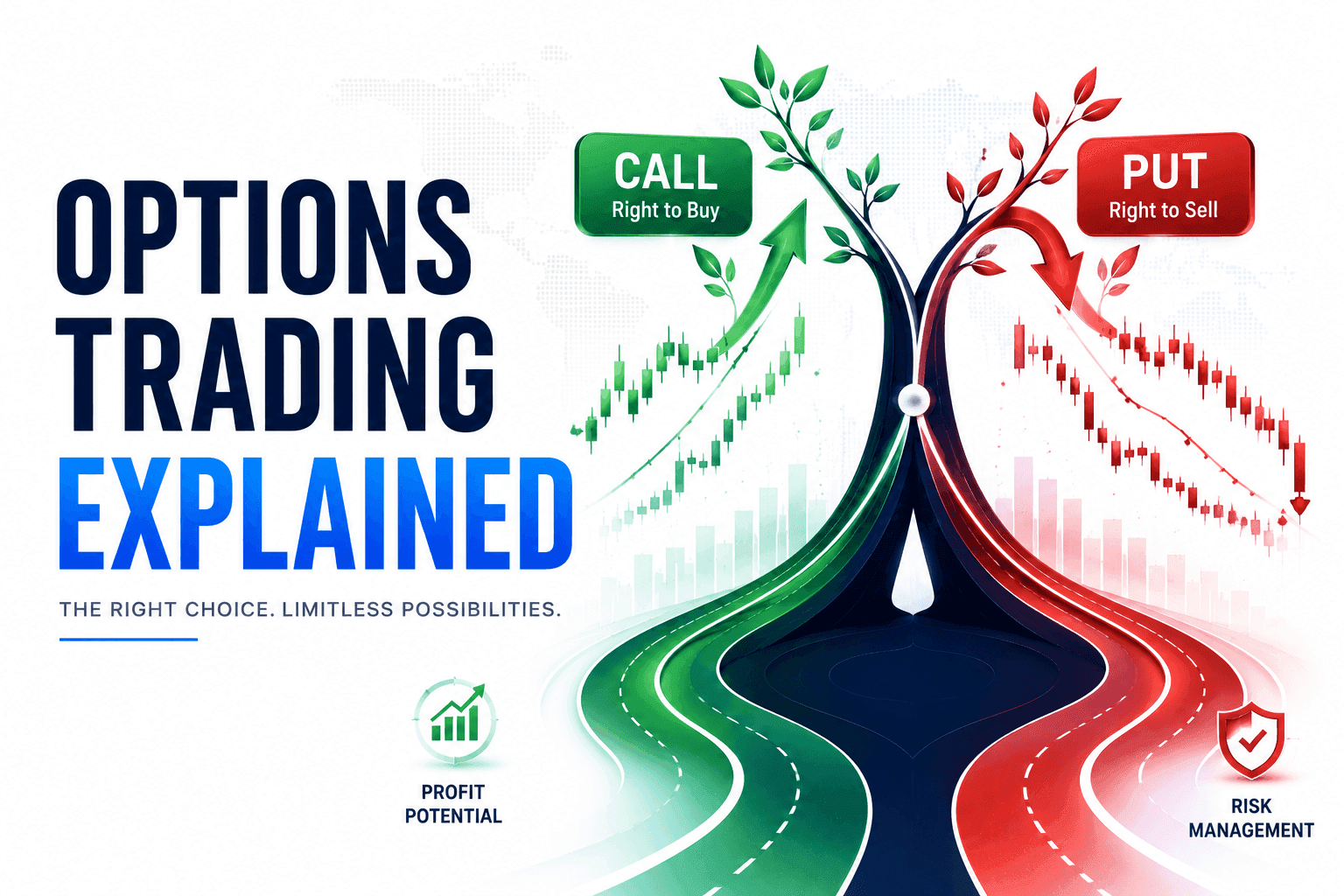
Call Options grant you the right to purchase an asset at a specific price. You'd typically buy calls when you expect the underlying asset's price to rise.
Put Options give you the right to sell an asset at a specific price. Put options become valuable when you anticipate the underlying asset's price will decline.
Every options contract involves four key components that determine its value and behavior. The strike price represents the price at which you can exercise the option. The expiration date sets the deadline for using your rights under the contract. The premium is the cost you pay to purchase the option. Finally, the underlying asset could be stocks, ETFs, commodities, or other securities.
Essential Options Trading Terminology
Mastering options requires familiarity with specific terminology that experienced traders use regularly.
Intrinsic value measures how much an option would be worth if exercised immediately. For call options, this equals the difference between the current stock price and strike price (when positive). Put options have intrinsic value when the strike price exceeds the current stock price.
Time value represents the additional premium investors pay based on the time remaining until expiration. Options lose time value as expiration approaches, a phenomenon called time decay.
Volatility significantly impacts options pricing. Implied volatility reflects market expectations of future price movements, while historical volatility measures past price fluctuations.
Understanding whether you're long (owning) or short (having sold) options determines your profit and loss profile. Being in-the-money means your option has intrinsic value, while out-of-the-money options only possess time value.
Popular Options Trading Strategies for Beginners
Starting with straightforward strategies helps you understand options mechanics before advancing to complex positions.
Buying Calls
Purchasing call options allows you to participate in upward price movements with limited risk. Your maximum loss equals the premium paid, while profit potential remains theoretically unlimited. This strategy works best when you expect significant price increases within the option's timeframe.
Buying Puts
Put purchases provide portfolio protection or profit from declining prices. Like call buying, your risk is limited to the premium paid. Many investors use puts as insurance against portfolio losses during market downturns.
Covered Calls
This income-generating strategy involves owning stock while selling call options against those shares. You collect premium income but cap your upside potential at the strike price. Covered calls work well in sideways or modestly bullish markets.
Cash-Secured Puts
Selling puts while holding enough cash to purchase the underlying stock generates income and potentially allows you to buy stocks at desired prices. This strategy suits investors comfortable owning the underlying asset at the strike price.
Key Factors That Influence Options Pricing
Options pricing depends on several interconnected variables that create opportunities and risks for traders. Stock price movement directly affects options values. Call options increase in value as stock prices rise, while put values grow when stock prices decline.
Time remaining until expiration creates urgency in options markets. Longer-dated options command higher premiums because they provide more time for favorable price movements.
Implied volatility can dramatically impact options costs. High volatility environments increase option premiums, while low volatility periods reduce them. Understanding volatility cycles helps you time entries and exits more effectively. Interest rates and dividend payments also influence options pricing, though their effects are typically smaller than the primary factors mentioned above.
Risk Management in Options Trading
Successful options trading requires disciplined risk management practices that protect your capital while allowing for profit opportunities.
Set clear position sizing rules before entering trades. Many experienced traders risk no more than 1-2% of their portfolio on any single options position. This approach prevents devastating losses that could eliminate your trading capital.
Establish profit targets and stop-loss levels for each trade. Options can lose value rapidly due to time decay and volatility changes, making predetermined exit strategies essential.
Diversify across different underlying assets, expiration dates, and strategies. Concentration in single stocks or sectors increases your vulnerability to unexpected market events.
Monitor your positions regularly, especially as expiration approaches. Time decay accelerates in the final weeks before expiration, potentially eroding profitable positions quickly.
Common Mistakes New Options Traders Make
Learning from others' mistakes accelerates your development as an options trader while protecting your capital.
Buying out-of-the-money options with short time frames represents one of the most expensive mistakes beginners make. These "lottery ticket" trades rarely succeed and consistently drain trading accounts.
Ignoring implied volatility when entering positions leads to overpaying for options. High implied volatility often signals expensive options that may lose value even if your directional bias proves correct.
Holding options until expiration without active management destroys value through time decay. Most profitable options positions should be closed before expiration to capture remaining time value.
Trading without understanding the Greeks—mathematical measures of options sensitivity—leaves you unprepared for price changes. Delta, gamma, theta, and vega all impact your positions differently.
Building Your Options Trading Foundation
Success in options trading builds on solid preparation and realistic expectations about the learning curve involved. Start with paper trading or small positions while you develop your understanding. Most brokers offer virtual trading platforms that let you practice without risking real money.
Focus on liquid options with tight bid-ask spreads. Popular ETFs like SPY, QQQ, and IWM offer excellent liquidity and reasonable spreads for beginners.
Develop a trading plan that includes entry criteria, profit targets, and risk management rules. Emotional decision-making leads to costly mistakes that proper planning helps avoid.
Consider your options trading as part of your overall investment strategy rather than a separate activity. How do options positions align with your portfolio goals and risk tolerance?
Taking Your First Steps in Options Trading
Options trading offers sophisticated tools for managing risk and enhancing returns, but success requires dedication to learning and disciplined execution. The strategies and concepts covered here provide the foundation you need to begin exploring options markets safely.
Start with basic strategies like buying calls and puts before progressing to more complex approaches. Focus on understanding how options behave in different market conditions rather than chasing quick profits.
Ready to put this knowledge into practice? Consider opening a trading account with a regulated broker that offers comprehensive options trading platforms, educational resources, and responsive customer support. Look for features like advanced charting tools, real-time market data, and risk management capabilities that support your trading development.
Remember, successful options trading combines market knowledge with disciplined risk management and continuous learning. Take time to master the fundamentals before advancing to sophisticated strategies.