


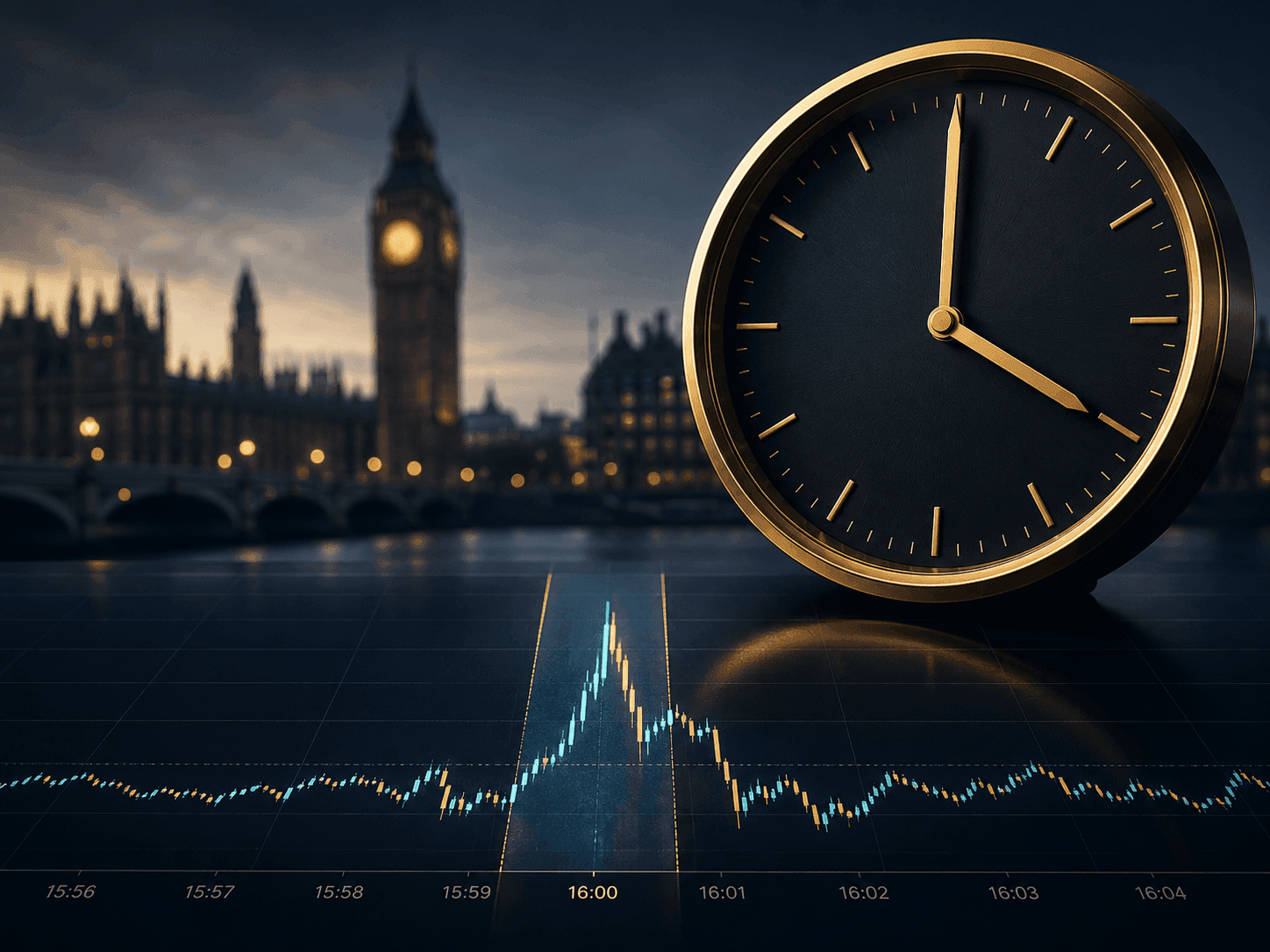
Every day at precisely 4 PM London time, a number is calculated that determines the value of trillions of dollars in investment portfolios, pension funds, and corporate hedges. The calculation takes two minutes. Almost nobody outside institutional finance knows it exists.
A pension fund in Oslo manages 200 billion dollars worth of global assets on behalf of Norwegian citizens. Every month, its investment committee rebalances the portfolio, selling some assets, buying others, shifting exposure across currencies and geographies. When they need to value those assets, convert between currencies, or settle transactions, they need a reference point. A single agreed price for a currency pair at a specific moment that every counterparty, every auditor, every regulator will accept without argument.
That reference point is the WM/Reuters fix. It is calculated once a day, at 4 PM London time, by averaging actual transaction prices across a two-minute window. It is not a traded price. It is a benchmark. And because trillions of dollars of contracts, hedges, and fund valuations are tethered to it, what happens in those two minutes, who is buying, who is selling, and whether the rate is being pushed, is one of the most consequential events in the daily forex market. It is also one of the least discussed ones.
The Scale of the Fix
$5T+ Daily forex volume referenced or settled against the 4 PM fix globally
2 min The calculation window, 30 seconds either side of 4 PM London
160+ Currencies for which the WM/Reuters fix publishes a daily benchmark rate
Why the Fix Exists
The fix was created in 1994 by WM Company and Reuters to solve a genuine problem: global investment funds needed a consistent, standardised exchange rate they could use to value international holdings and settle cross-currency transactions without each counterparty using a different reference price.
Before the fix, a fund and its custodian bank might use different rates for the same transaction, creating reconciliation nightmares across portfolios worth billions. The fix gave everyone the same number. One rate. Non-negotiable. Globally accepted.
How the 4 PM Fix Works
3:30 PM
Pre-fix quiet
Orders accumulate on bank desks.
Corporations, fund managers, and institutional clients submit fix orders to their banks throughout the morning and afternoon. By 3:30 PM, bank trading desks have aggregated significant order flow they will need to execute at or near the fix. They know which direction and roughly what size.
3:45 PM
Pre-positioning
Directional pressure begins building.
Banks and sophisticated participants begin managing their exposure ahead of the fix window. Order imbalances in one direction create early price pressure. The pattern is observable to anyone watching EUR/USD closely in the fifteen minutes before 4 PM, a directional drift that often predicts which way the fix will push the rate.
3:59:30 PM
Fix window opens
The two-minute calculation window begins.
Every transaction in the major currency pairs during this window is captured. The median bid and ask prices across the window become the fix rate. Large orders that were accumulated through the day are now being executed simultaneously by multiple banks. Volume spikes sharply. Price volatility compresses and then often snaps.
4:01:30 PM
Fix published
Rate published, and price often reverses.
The fix rate is published. Accumulated buy or sell pressure that was pushing the market during the window now dissipates. The orders are filled, the flow stops, and the price frequently snaps back toward pre-fix levels. This reversal pattern is one of the most consistent and most studied phenomena in intraday forex.
What the Market Actually Looks Like
It is 3:57 PM on a Tuesday. EUR/USD has been drifting higher for the past twelve minutes with no obvious news catalyst. A careful observer notices the move lacks the follow-through of a genuine breakout. It is mechanical, orderly, steady.
At 4:01:30, the fix publishes.
EUR/USD drops twenty pips in ninety seconds and trades back to where it was at 3:45 PM.
What just happened was not a failed breakout or a stop hunt in the traditional sense. It was a fix order, a large corporate hedge or fund rebalancing flow, being executed by a bank that needed to buy euros at the fix rate.
The bank accumulated the position in the minutes before the window, pushed the price upward through its own buying, executed its fix order at the elevated rate, and exited the pre-position as the fix closed.
The corporate client got the benchmark rate. The bank captured the difference between where it bought and where the fix settled.
The candle pattern on the chart recorded only the price movement. Nobody who saw the chart knew why it moved.
Who Uses the Fix
Largest users
Index fund managers
When a stock joins or leaves a major index, passive funds tracking that index must trade at the same reference rate to avoid tracking error against the benchmark. The fix provides that reference.
Daily users
Custodian banks
Portfolio valuations, dividend conversions, and multi-currency settlement for institutional clients all require a consistent daily rate. The fix gives custodians and their clients an agreed reference nobody disputes.
Monthly users
Corporate treasuries
Multinationals consolidating overseas subsidiary revenues into a reporting currency at month-end need a recognised benchmark rate. Using the fix means the rate is defensible to shareholders and auditors.
Structural users
Pension and sovereign funds
Rebalancing programmes that shift billions across currency zones require a rate every participant in the chain accepts. The fix removes the negotiation entirely, and the trillions concentrated here at month-end are why certain fix windows produce the largest intraday moves of the month.
"The 4 PM fix is not where the market discovers the price. It is where the market is forced to transact at whatever price the accumulated order flow of the day has pushed it to, and that is a very different thing."
The FX Scandal
The 2013 to 2015 FX scandal exposed what happened when bank traders coordinated to push the fix in their favour before the window opened.
Sharing client order information through chatrooms such as "The Cartel" and "The Mafia," they pre-positioned, moved the rate during the fix, and profited from the spread between where they accumulated and where the benchmark settled.
The fines totalled over ten billion dollars across six banks.
The fix methodology was subsequently reformed: the window was extended from sixty seconds to two minutes, and the calculation method was made more rigorous.
Whether the reform was sufficient remains an open question among those who watch the pattern closely.
What Traders Should Watch
Know this
The fifteen minutes before 4 PM London time, from 3:45 to 4 PM, show consistent directional price drift on the days with large fix order imbalances.
Month-end, quarter-end, and index rebalancing dates produce the largest imbalances and the most observable pre-fix drift.
Watching EUR/USD and GBP/USD behaviour in this window over several weeks reveals a pattern that has nothing to do with technical analysis.
Watch for
The post-fix reversal.
When price moves strongly into the 4 PM window and then snaps back within ninety seconds of the fix publishing, the move was mechanically driven by order flow, not by a genuine change in sentiment or fundamentals.
The reversal is the market returning to where it would have been without the concentrated fix flow.
Trading the reversal rather than chasing the pre-fix move is where the structural edge lies.
For Dubai Traders
The 4 PM London fix lands at 8 PM Dubai time, well within the early evening, a civilised hour with full cognitive capacity available.
The pre-fix drift window from 7:45 to 8 PM is observable in real time without any session management pressure.
For a UAE-based trader who has run through the analytical framework built throughout this series, this window represents one of the most structurally predictable recurring events in the daily forex market: legible, repeating, and accessible at a comfortable hour.
The Real Point
The Norwegian pension fund that triggered this entire explanation does not care about the pre-fix drift or the post-fix reversal. It cares that its currency conversions settle at a rate its auditors will accept without a single question.
The fix serves that purpose perfectly.
And the structural predictability that creates is, for traders paying close enough attention, one of the few genuinely repeating patterns in a market that resists almost every attempt to find them.