


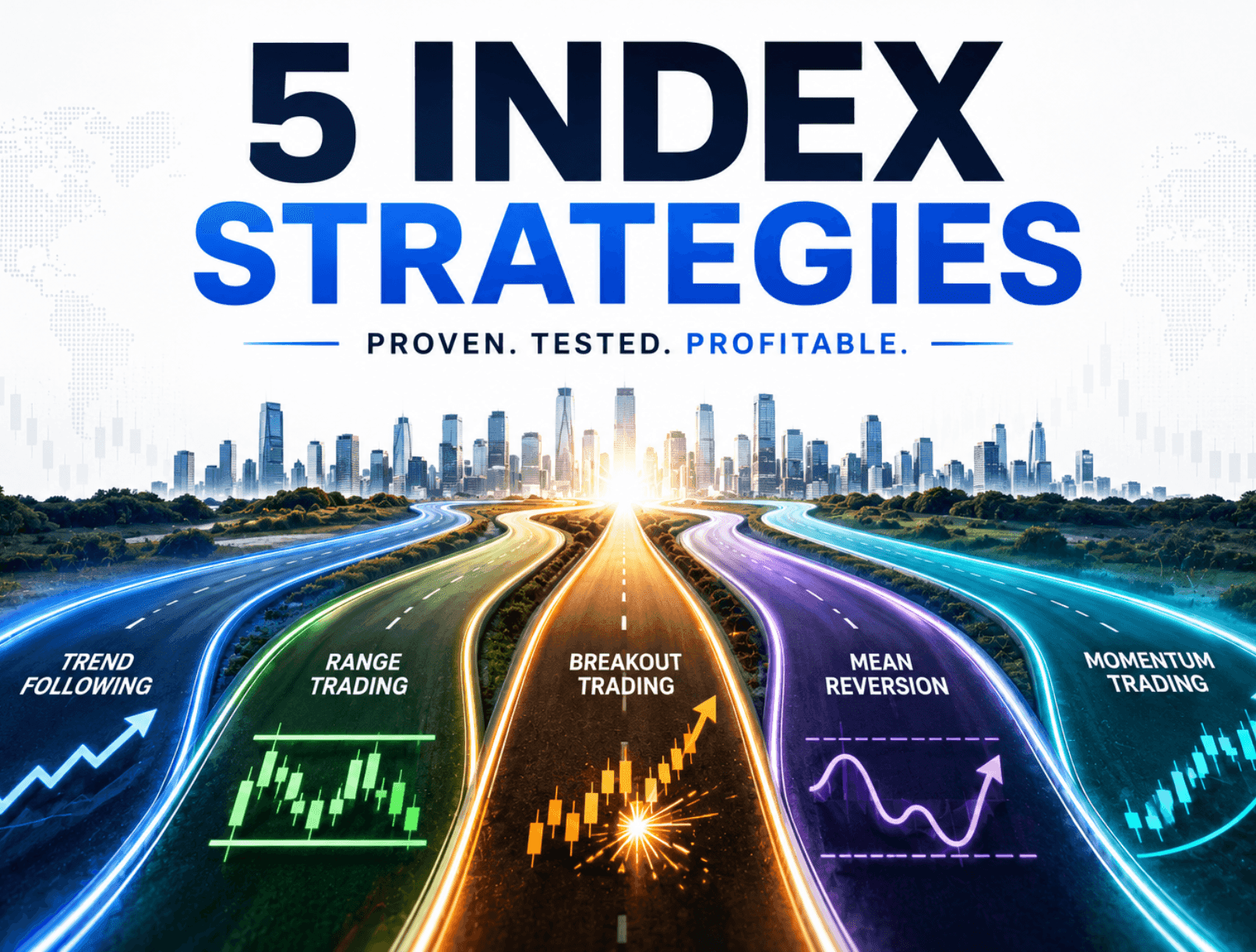
Index trading offers one of the most efficient ways to gain exposure to entire markets without picking individual stocks. Whether you're tracking the S&P 500, FTSE 100, or emerging market indices, these proven strategies can help you navigate market movements with confidence and precision.
Index trading has become increasingly popular among both novice and experienced traders due to its built-in diversification and reduced single-stock risk. Unlike individual equity trading, index trading allows you to benefit from overall market trends while minimizing the impact of company-specific volatility.
This comprehensive guide explores five battle-tested index trading strategies that have consistently delivered results across different market conditions. We'll examine the mechanics behind each approach, when to implement them, and how to manage risk effectively.
Understanding Index Trading Fundamentals
Before diving into specific strategies, it's essential to grasp what makes index trading unique. Stock indices represent a basket of securities that track the performance of a specific market segment, sector, or geographical region. Major global indices like the Dow Jones Industrial Average, NASDAQ 100, and Germany's DAX provide traders with exposure to hundreds or thousands of underlying stocks through a single instrument. This diversification naturally reduces the risk associated with individual company failures or sector-specific downturns.
Key advantages of index trading include:
-
Lower volatility compared to individual stocks
-
Reduced research requirements
-
Protection against company-specific risks
-
Access to entire economies or sectors
-
Higher liquidity and tighter spreads
Strategy 1: Trend Following with Moving Averages
Trend following remains one of the most reliable approaches to index trading. This strategy capitalizes on sustained directional movements in major indices by using moving averages to identify and confirm trends.
How It Works
The strategy employs two exponential moving averages (EMAs): a shorter period (typically 12-day) and a longer period (usually 26-day). When the shorter EMA crosses above the longer EMA, it signals a potential uptrend. Conversely, when the shorter EMA crosses below the longer EMA, it indicates a possible downtrend.
Entry signals:
-
Long position: Enter when the 12-day EMA crosses above the 26-day EMA
-
Short position: Enter when the 12-day EMA crosses below the 26-day EMA
Risk Management
Set stop losses at 2-3% below your entry point for long positions and 2-3% above for short positions. This approach helps preserve capital during false breakouts while allowing profitable trends to develop.
Best suited for: Traders who prefer longer holding periods and can withstand temporary market noise.
Strategy 2: Range Trading in Sideways Markets
Not all market conditions favor trending strategies. During periods of consolidation, indices often trade within defined ranges, creating opportunities for range-bound trading approaches.
Identifying Range-Bound Markets
Range trading works best when indices consistently bounce between established support and resistance levels. Look for periods where the index fails to make new highs or lows for at least 3-4 weeks.
Key execution points:
-
Buy near support levels with tight stop losses
-
Sell near resistance levels with predefined profit targets
-
Use oscillators like RSI to confirm overbought/oversold conditions
Implementation Guidelines
Enter long positions when the index approaches the lower boundary of the range and RSI readings fall below 30. Exit these positions as the index nears the upper range boundary or RSI exceeds 70.
For short positions, reverse this approach: enter when the index reaches resistance levels with RSI above 70, and exit near support or when RSI drops below 30.
Strategy 3: Breakout Trading for Volatility Expansion
Breakout strategies excel during periods of increased market volatility, particularly around major economic announcements or earnings seasons. This approach aims to capture significant price movements that occur when indices break through established support or resistance levels.
Setting Up Breakout Trades
Monitor indices that have been consolidating within narrow ranges for extended periods. These consolidation phases often precede explosive moves in either direction.
Essential breakout criteria:
-
Volume confirmation: Breakouts should occur on above-average trading volume
-
Clean break: The index should close decisively above resistance or below support
-
Follow-through: Look for continued movement in the breakout direction
Managing Breakout Positions
Enter positions immediately upon confirmed breakouts, but be prepared for potential false breaks. Set initial stop losses just inside the previous range, and use trailing stops to protect profits as the move develops.
Strategy 4: Mean Reversion During Oversold Conditions
Mean reversion strategies capitalize on the tendency of indices to return to their average values after extreme movements. This approach works particularly well with major indices that have strong long-term upward bias.
Identifying Mean Reversion Opportunities
Look for situations where indices have declined rapidly over short periods, creating oversold conditions. Use technical indicators like the Relative Strength Index (RSI) or Bollinger Bands to identify these extreme readings.
Entry conditions:
-
RSI below 25 for at least two consecutive days
-
Index trading near the lower Bollinger Band
-
No significant fundamental reasons for continued decline
Execution and Exit Strategy
Enter long positions gradually as oversold conditions develop, rather than committing full position size immediately. This approach allows you to average down if conditions worsen temporarily.
Exit positions when RSI returns to neutral levels (around 50) or when the index reaches the middle Bollinger Band. This conservative exit strategy helps lock in profits before potential reversals.
Strategy 5: Momentum Trading with Multiple Timeframes
Momentum trading combines analysis across multiple timeframes to identify and trade strong directional moves in indices. This strategy proves particularly effective during earnings seasons and major economic announcements.
Multi-Timeframe Analysis
Begin with daily charts to identify the overall trend direction, then use hourly charts for precise entry timing. This approach helps ensure your trades align with both short-term momentum and longer-term trends.
Confirmation process:
- Daily chart shows clear trending behavior
- Hourly chart confirms momentum in the same direction
- Volume supports the directional move
Position Management
Enter positions when both timeframes align, using the hourly chart for precise timing. Set stop losses based on daily chart support/resistance levels, providing room for normal intraday fluctuations while protecting against trend reversals.
Risk Management Across All Strategies
Regardless of which strategy you employ, proper risk management remains crucial for long-term success. Never risk more than 2% of your trading capital on any single trade, and always define your exit strategy before entering positions.
Universal risk management principles:
-
Position sizing based on account balance
-
Predetermined stop loss levels
-
Regular portfolio review and adjustment
-
Diversification across multiple indices and timeframes
Consider using correlated indices to hedge positions during uncertain market conditions. For example, if you're long on the S&P 500, you might consider a smaller short position in a more volatile index to reduce overall portfolio risk.
Choosing the Right Strategy for Market Conditions
Different market environments favor different approaches. Trending markets reward momentum and trend-following strategies, while range-bound markets favor mean reversion and range trading approaches.
Market condition assessment:
-
Strong trends: Use momentum and trend-following strategies
-
Consolidation phases: Implement range trading and mean reversion
-
High volatility: Focus on breakout strategies with tight risk management
-
Low volatility: Prepare for eventual breakout opportunities
Building Your Index Trading Foundation
Success in index trading requires more than just strategy selection. Develop a comprehensive understanding of the indices you're trading, including their components, sector weightings, and historical behavior patterns.
Major indices often correlate with specific economic indicators and market sectors. The technology-heavy NASDAQ 100 responds differently to interest rate changes compared to the broader S&P 500, while emerging market indices may be more sensitive to currency fluctuations and geopolitical events.
Stay informed about macroeconomic factors that drive index movements, including central bank policies, economic data releases, and global trade developments. This fundamental awareness enhances your ability to anticipate potential strategy adjustments.
Remember that no single strategy works in all market conditions. The most successful index traders adapt their approaches based on current market dynamics while maintaining strict risk management discipline. Start with one strategy that matches your risk tolerance and time availability, then gradually expand your toolkit as you gain experience and confidence.
With proper implementation and disciplined execution, these five strategies provide a solid foundation for consistent index trading performance across various market environments.