


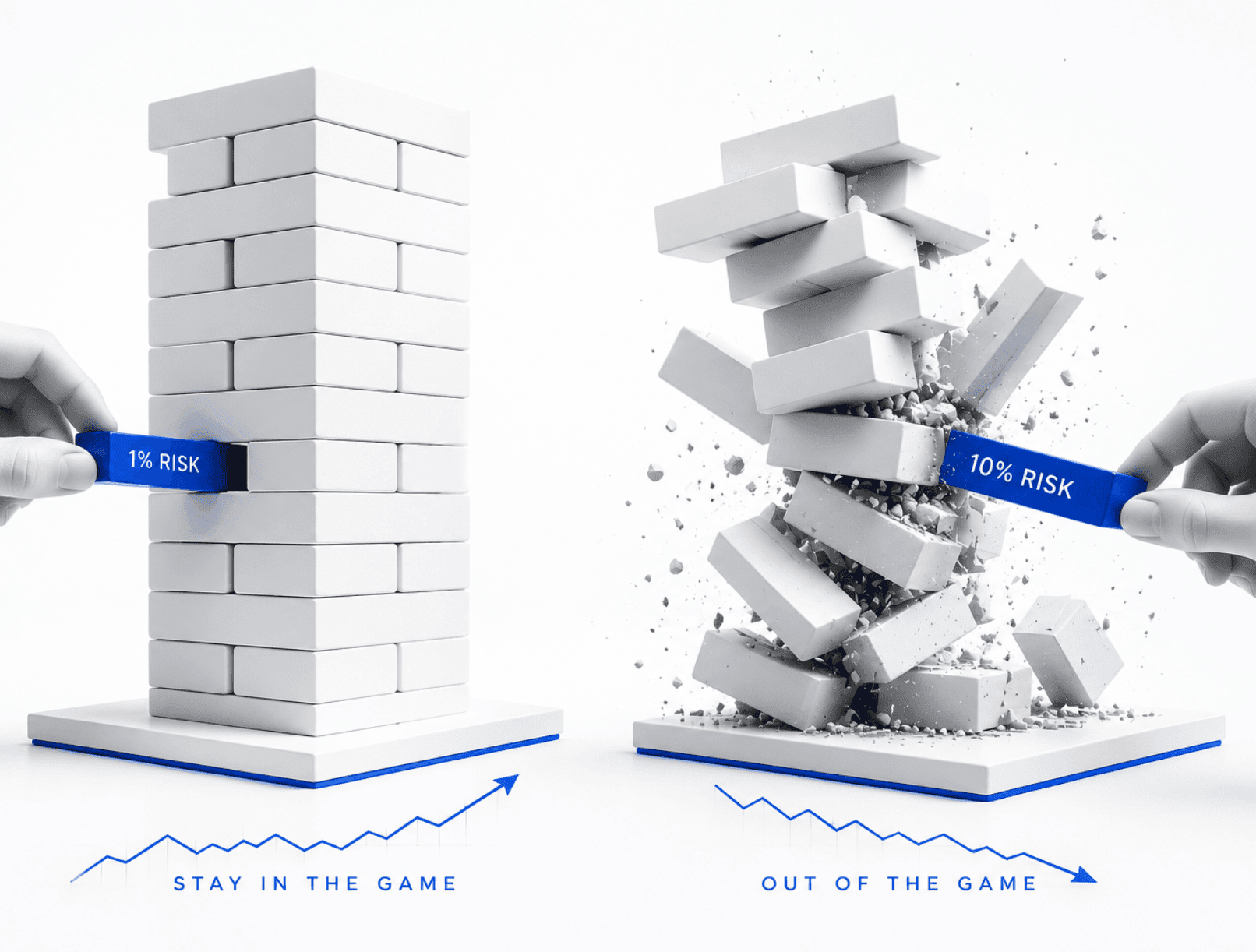
Two traders. Identical strategies. One survives five years. The other blows up in eight months. The difference is rarely what they traded, it is almost always how much they traded at once.
In 2019, a prop trading firm in London ran an internal study across its junior trader cohort. All of them had access to the same research, the same execution platform, the same market data. By the end of year one, the traders with the highest win rates were not necessarily the ones still standing. A handful of traders with win rates below fifty percent had grown their accounts steadily while several traders with sixty-percent win rates had been cut after catastrophic drawdowns. The study's conclusion was uncomfortable and unambiguous: what separated the survivors from the casualties was not analytical ability. It was position sizing. The traders who survived knew how much not to risk. The ones who washed out never learned the difference between being right and being solvent.
Position sizing is not glamorous. It does not appear on trading course sales pages. Nobody builds a following on social media by explaining lot size calculations. Yet every serious, consistently profitable trader, institutional or independent, will tell you the same thing: the entry strategy matters far less than the risk framework that surrounds it. A mediocre strategy with disciplined position sizing outlasts a brilliant strategy applied recklessly, every single time.
The mathematics are unforgiving and worth sitting with. Losing streaks happen to every trader, not as a sign of failure but as a statistical certainty. Even a strategy with a sixty-percent win rate will produce sequences of five or six consecutive losses. The question is not whether those sequences will occur. It is whether the position sizes during those sequences permit survival long enough to reach the next winning run.
Risk 2% Per Trade
Maximum damage from 10 consecutive losses: -18%
Painful but recoverable. Requires a 22% gain to return to breakeven.
Risk 5% Per Trade
Maximum damage from 10 consecutive losses: -40%
Severe. Requires a 67% gain just to break even, a psychological and mathematical recovery most traders never complete.
Risk 10% Per Trade
Maximum damage from 10 consecutive losses: -65%
Functionally terminal for most retail accounts. Requires a 186% gain to recover, which demands the same reckless risk-taking that caused the collapse in the first place.
The asymmetry of losses is the trap most traders discover too late. Losing twenty percent requires a twenty-five percent gain to recover. Losing fifty percent requires a hundred percent gain. Losing seventy percent requires a two-hundred-and-thirty-three percent gain. The mathematics do not care about conviction level, the quality of the setup, or how certain the trade felt. A large loss imposes a compounding recovery problem that grows faster than most strategies can realistically address. Keeping losses small is not conservative. It is mathematically mandatory for long-run survival.
The Position Size Calculation
Working backward from risk tolerance, not forward from lot size preference
Position size = (Account balance × Risk %) ÷ (Stop-loss in pips × Pip value)
A $10,000 account risking 1% per trade with a 40-pip stop on EUR/USD:
($10,000 × 0.01) ÷ (40 × $10) = $100 ÷ $400 = 0.25 standard lots
The stop placement comes first. The position size follows from it, never the reverse.
Two traders both take the same EUR/USD long at 1.0850, stop at 1.0800, target at 1.0950. Trader A sizes the position based on the formula above, risking one percent of a $20,000 account and arriving at 0.4 lots. Trader B sizes it based on feel and goes in with two standard lots because the setup feels exceptional.
Both get stopped out.
Trader A loses $200, two percent of the account, uncomfortable but inconsequential.
Trader B loses $1,000, five percent on a single trade.
After four such losses in a month, Trader B has lost twenty percent of the account and is trading from a place of pressure rather than process.
Same trade. Same analysis. Entirely different outcomes, produced entirely by position size.
"The best traders in the world are not the ones who are right most often. They are the ones who survive being wrong often enough to reach the trades where being right compounds into something meaningful."
Mistake
1. Sizing up after wins, sizing down after losses
Increasing position size on a winning streak and reducing it during a losing streak produces the worst possible outcome: maximum exposure at the peak of confidence, minimum exposure at the moment a strategy's natural edge is about to reassert itself.
2. Moving the stop to accommodate a preferred position size
Placing a stop at a structurally illogical location simply because the mathematically correct location would require a smaller lot size. The stop placement must be determined by the chart, not by the desired position size. Inverted logic is how technically correct stops become irrelevant.
How to Fix
1. Flat risk across every trade, regardless of conviction
The highest-conviction trade of the month and the routine setup get the same percentage risk. Conviction is subjective and systematically biased. Traders feel most certain at exactly the moments market structure has been manipulated to produce that certainty. Flat risk eliminates the sizing mistake that high conviction produces.
2. Maximum drawdown thresholds that trigger a pause
Define in advance: if the account drops by ten percent in a calendar month, trading stops for the remainder of the month. No exceptions. This rule does not prevent losses. It prevents the spiral where losses produce emotional decisions that produce larger losses. The pause is not defeat. It is circuit protection.
None of this is complicated. The calculation takes thirty seconds. The discipline required to apply it consistently, across every trade, in every market condition, regardless of how certain the setup feels, that is the actual work.
Every trader who has ever blown an account knew the rules. Knowing and doing are separated by the same gap that separates traders who survive from traders who do not. Position sizing is where that gap either closes or widens, one trade at a time.